The Future of Classic Car Collecting: Trends Shaping the Next Generation
The future of classic car collecting: why 2035 ICE bans spare existing cars, plus e-fuels, shifting demographics, electromods and fractional ownership trends.…
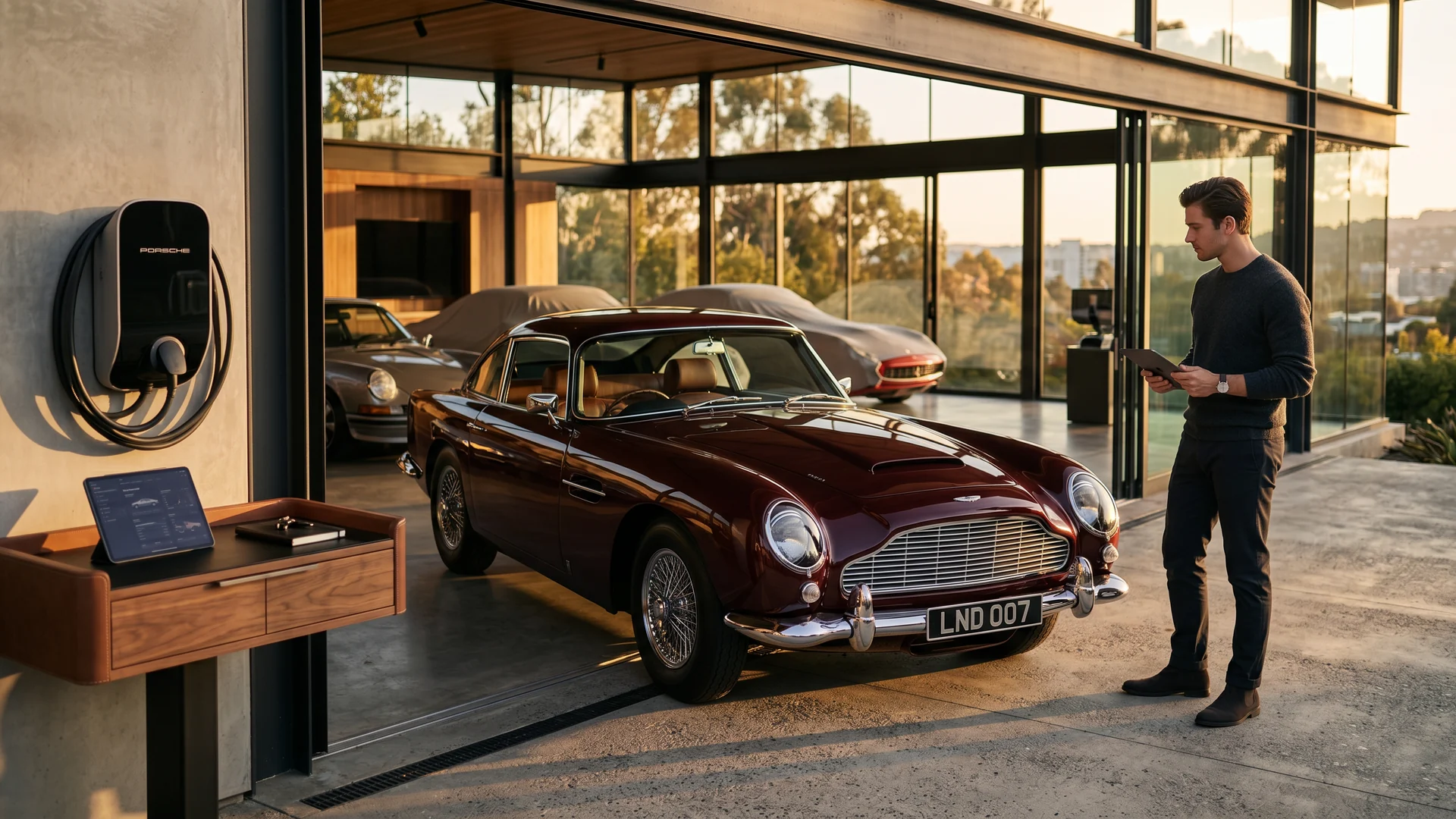
The future of classic-car collecting is a transition, not a cliff: ICE bans target only new-vehicle sales, while e-fuels, younger buyers and analog appeal keep historic cars relevant.
Key Takeaways
- The EU's 2035 ICE ban and similar US and UK targets apply only to the sale of new vehicles; owning, restoring, selling and driving existing classic cars remains legally protected.
- Bodies like the Federation Internationale des Vehicules Anciens, the Historic Vehicle Association and the FBHVC have long secured legal protections for historic vehicles, predating electrification mandates.
- Porsche's synthetic e-fuel, made with Siemens Energy and HIF Global at the Haru Oni plant in Punta Arenas, Chile, cuts CO2 by about 85 percent and works in unmodified engines; the EU 2035 ban carves out carbon-neutral fuels.
- Baby boomers (born 1946-1964) have driven the market since the 1980s, but a 2023 Hagerty survey found 62 percent of Millennials and 41 percent of Gen Z interested in owning a classic car.
- Younger buyers favor 1980s-2000s Radwood-era cars, Japanese icons like the Nissan Skyline GT-R and Toyota Supra Turbo, air-cooled Porsche 911s and BMW M cars, while pre-war Packards and Duesenbergs face price headwinds.
- Electromod firms such as Lunaz Design (backed by David Beckham), Everrati and ECD Automotive Design convert classics to electric power for 350,000 to over 1 million pounds, creating a separate market that purists reject.
- Fractional-ownership platforms like Rally and Otis sell SEC-registered shares in cars such as a 1976 Lamborghini Countach LP400 and a 1985 Ferrari Testarossa, potentially broadening the collector base.
🌐 Also available in: Deutsch
The Future of Classic Car Collecting: Electrification, Demographics, and the Market’s Next Chapter
The classic-car world stands at a crossroads unlike any it has faced in the history of the hobby. The regulatory push toward vehicle electrification, the shifting demographics of the collector base, the evolving definition of what constitutes a classic car, the emergence of new technologies, synthetic fuels, electric conversions, digital ownership platforms, and the inexorable advance of time itself are reshaping the collector-car landscape in real time, with consequences that will unfold over the coming decades. Will the internal-combustion classics that dominate today’s auction headlines retain their relevance, their values, and their cultural significance in a world moving toward zero-emission mandates? Who will collect and care for these cars when the baby-boomer generation, the demographic engine that has powered the post-war collector-car market for over four decades, ages out of active participation and passes its collections to heirs with different tastes and different priorities? This article examines the forces that are reshaping classic-car collecting, evaluates the evidence rather than indulging in speculation, and offers a clear-eyed assessment of what the coming decades are likely to bring for those who love, collect, and preserve historic automobiles.
The Internal-Combustion Ban: What It Actually Means
Much of the anxiety within the classic-car community about the future of the hobby centers on the legislative and regulatory push to phase out the sale of new internal-combustion-engine vehicles. The European Union has legislated what amounts to a de facto ban on the sale of new ICE vehicles from 2035, with intermediate targets requiring a 55 percent reduction in fleet-average CO2 emissions by 2030 relative to 2021 levels. The United Kingdom, California, and several other American states that collectively represent approximately 40 percent of the United States new-car market under the Clean Air Act waiver framework have adopted similar targets on similar timelines. These policies have generated enormous and often heated discussion within the classic-car community, much of it based on misunderstandings of what the legislation actually does and does not do.
The critical point, which cannot be stated too clearly or too often, is that these bans apply exclusively to the sale of new vehicles. No jurisdiction in the world has proposed, and no responsible political figure has advocated for, banning the ownership, operation, sale, or restoration of existing vehicles. The organized classic-car lobby, represented internationally by the Fédération Internationale des Véhicules Anciens and nationally by organizations like the Historic Vehicle Association in the United States, the Federation of British Historic Vehicle Clubs in the United Kingdom, and dozens of similar organizations worldwide, has been consistently effective over many decades at securing legislative and regulatory protections for historic vehicles. These protections are not recent responses to electrification mandates; they are the product of sustained advocacy that predates the current policy debates by many years. The right to own, restore, and operate historic vehicles on public roads is well established in law and is not seriously threatened by any current or proposed legislation.
However, the practical impact of the transition away from internal combustion extends beyond the letter of the law and into the fabric of the infrastructure that supports classic-car ownership. As the vehicle fleet electrifies over the coming decades, a transition that will take far longer than the headline targets suggest, the economics of the petroleum-refining and retail-fueling industries will shift. Gas stations in areas with low population density may become economically unviable as demand for gasoline declines, and the number of retail fueling locations will contract over time. For the classic-car owner who enjoys long-distance touring in remote areas, finding fuel may eventually require more planning than it does today, though the process will be gradual and regional rather than sudden and universal. Specialist mechanics with deep knowledge of internal-combustion engines, carburetion, and the other systems that define classic cars will become scarcer and more expensive as the generation that grew up working on these systems retires. Urban low-emission zones, of which London’s Ultra Low Emission Zone, Paris’s Zone à Circulation Restreinte, and similar schemes in dozens of European and Asian cities are the leading edge, impose daily charges on vehicles that do not meet modern emissions standards, including virtually all classic cars. These charges are currently modest, £12.50 per day in London’s ULEZ, but they represent a friction that will shape how and where classic cars are driven in urban areas. None of these developments represents an existential threat to the hobby, but they are real factors that will influence the ownership experience over the coming decades and should be understood and planned for rather than ignored.
Synthetic Fuels: The Potential Savior of Internal Combustion
The most significant and potentially transformative development for the future of the internal-combustion classic car is the emergence of synthetic fuels, also known as e-fuels. These fuels are produced by using renewable energy to electrolyze water into hydrogen, capturing carbon dioxide from the atmosphere or from industrial sources, and combining the hydrogen and CO2 through chemical synthesis to produce liquid hydrocarbons that are chemically identical to conventional gasoline and can be used in any internal-combustion engine without modification to the engine or to the fuel system. Porsche, in partnership with Siemens Energy, the Chilean company HIF Global, and other partners, has invested heavily in the development and production of e-fuels at the Haru Oni pilot plant in Punta Arenas, in the far south of Chile, where consistently strong winds provide the renewable electricity to power the electrolysis process. Porsche’s e-fuel is chemically indistinguishable from conventional gasoline and has been demonstrated in the company’s own historic vehicles including 911s from the 1960s and 1970s. The company claims that its e-fuel reduces CO2 emissions by approximately 85 percent on a well-to-wheel basis compared to conventional gasoline refined from crude oil.
The production volumes are currently tiny: Porsche produced 130,000 liters in 2024, with plans to scale to 55 million liters by 2026 and 550 million liters by 2028, but the trajectory is upward and the technology is proven at industrial scale. The energy economics of e-fuels are inherently challenging: the round-trip efficiency from renewable electricity to motive power at the wheels is approximately 16 percent, compared to roughly 75 percent for a battery-electric vehicle, meaning that e-fuels require nearly five times as much renewable electricity per mile driven. For the mass market of daily-driver vehicles covering 12,000 to 15,000 miles annually, this inefficiency makes e-fuels a non-starter compared to direct electrification. But for the low-mileage, enthusiast-driven use case that defines the classic-car hobby, that inefficiency may be perfectly tolerable. A classic car driven 1,500 miles per year at 15 miles per gallon consumes 100 gallons of fuel, and the premium paid for e-fuel over conventional gasoline at that volume is a rounding error in the context of the total cost of classic-car ownership. The European Union’s 2035 ban includes a specific carve-out for internal-combustion vehicles that run exclusively on carbon-neutral fuels, and the advocacy of Porsche, Ferrari, and other manufacturers with significant heritage and high-performance interests is driving a broader policy conversation about e-fuels as a complement to, rather than a competitor to, electrification.
The Demographic Shift: Who Will Collect the Cars of Yesterday?
The classic-car market’s most profound long-term challenge is not regulatory but demographic. The baby-boomer generation, born between 1946 and 1964, has been the primary engine of collector-car demand since the 1980s, when they entered their peak earning years and began acquiring the cars they had admired in their youth. These buyers accumulated significant wealth, retired with the time to devote to the hobby, and collected the cars of their formative years: 1950s and 1960s American muscle cars, 1950s European sports cars, pre-war classics that represented the pinnacle of automotive craftsmanship. As this generation ages out of active collecting, downsizing their collections, selling cars to fund retirement, or passing their beloved machines to heirs who may not share their enthusiasm, the market faces a significant supply-demand imbalance in certain segments. The cars that boomers cherish are not necessarily the cars that younger generations covet with equal passion, and this divergence of taste has profound implications for values in the decades ahead.
The evidence for this demographic shift is accumulating in the data. Hagerty’s research shows that Generation X, born between 1965 and 1980, and Millennials, born between 1981 and 1996, are increasingly active in the classic-car market. A 2023 Hagerty survey found that 62 percent of Millennial respondents expressed genuine interest in owning a classic car, and an encouraging 41 percent of Gen Z respondents, the generation born after 1996, whose oldest members are now in their late twenties, agreed that they would like to own one. The cars they want, however, differ markedly from the traditional collector-car canon. Younger buyers show a strong preference for cars from the 1980s, 1990s, and 2000s, the Radwood era of digital dashboards, pop-up headlights, and wedge-shaped bodywork. Japanese performance icons from the golden age of the segment: the Nissan Skyline GT-R in all its generations, the Toyota Supra Turbo, the Acura and Honda NSX, the Mazda RX-7, the Mitsubishi Lancer Evolution. Air-cooled Porsche 911s from the G-Series through the 993 generation. BMW M cars from the E30 M3 that defined the genre to the E46 M3 that is widely considered the high-water mark of the naturally aspirated M lineage. Modern supercars from the Ferrari F40, F50, and Enzo through the Porsche Carrera GT. These are the cars that adorned bedroom walls, appeared in video games, and starred in films during the formative years of today’s younger collectors. The supply of clean, unmodified, well-documented examples of these cars is finite and shrinking, while demand from a new generation of buyers is growing. This is the classic recipe for sustained appreciation.
The impact of this demographic shift on pre-war and early post-war cars is already visible and is likely to intensify. A 1930s Packard or Duesenberg that would have been a marquee consignment at a major auction in 2005 now faces a shrinking pool of potential buyers willing to bid aggressively. The Hagerty 1950s American Classics Index has underperformed the broader collector-car market over the past decade, a trend that most market analysts expect to continue. This does not mean that pre-war and early post-war cars will become worthless, the very best examples of historically significant models, particularly those with documented provenance and concours-winning condition, will always find buyers at the highest levels of the market, in the same way that Renaissance paintings and antique furniture of museum quality continue to trade among a small group of connoisseurs even as the broader market for such objects has contracted. But it does mean that the broad middle of the pre-war and early post-war market, the good but not exceptional cars that appealed to a generation of collectors for whom these vehicles represented the cars of their parents’ or grandparents’ era, will face persistent price headwinds as the collector base ages and contracts.
The Electromod Movement: Controversy and a New Market Segment
One of the most visible and controversial responses to the electrification trend is the emergence of the electromod, a classic car whose original internal-combustion drivetrain has been removed and replaced with an electric motor, battery pack, and associated control systems. Companies like Lunaz Design in the United Kingdom have attracted significant investment, including from David Beckham, to convert classic Jaguar XK120s, Range Rovers, Bentley S2 Continentals, and other iconic vehicles to electric power at costs ranging from £350,000 to well over £1 million per conversion. Everrati, based in the UK, electrifies Porsche 911s of the 964 generation and Land Rover Series IIAs. ECD Automotive Design in Florida offers electric-converted Land Rover Defenders and Jaguar E-Types alongside its traditional restorations. The reception from traditional collectors has been, to put it charitably, mixed, and in some quarters it has been actively hostile. Purists regard the removal of a classic car’s original engine, the beating heart of the machine, the component that defines its character and sound and historical identity, as an act of desecration, the permanent destruction of the car’s integrity and a substantial portion of its financial value. The market has largely validated this view: an electric-converted 1960s Porsche 911 currently commands nowhere near the value of an original, numbers-matching, air-cooled example, and it is unlikely that this differential will reverse, because the car’s originality, the quality that the collector market values above almost all others, has been permanently altered.
However, the electromod segment is creating its own market rather than competing directly with the traditional collector market. The buyers of Lunaz and Everrati conversions are typically technology entrepreneurs, sustainability-focused investors, and individuals who value the aesthetics and design of a classic car but have no interest in the maintenance, noise, and emissions of an internal-combustion engine. They are often first-time entrants to the classic-car world, people who would never have purchased a traditional classic but are drawn to the concept of a beautifully restored classic body combined with a modern, silent, zero-emission powertrain. This is a small market segment today, but it is growing, and it represents one vision, controversial but valid, of how classic cars might remain relevant and used in a world that is gradually electrifying.
Digital and Fractional Ownership: Democratizing the Market
New ownership models enabled by financial technology are beginning to reshape access to the classic-car market in ways that could broaden the collector base beyond the traditional demographic of wealthy individuals. Platforms like Rally and Otis have pioneered fractional ownership of collectible assets, art, wine, memorabilia, and now automobiles, where investors purchase shares in a specific vehicle through an offering registered with the Securities and Exchange Commission. These platforms have funded cars ranging from a 1976 Lamborghini Countach LP400, the pure early wedges that purists favor, to a 1985 Ferrari Testarossa and a 1995 Porsche 911 Carrera RS. The fractional model introduces a new cohort of investors with a financial interest in the classic-car market, some of whom may eventually graduate to whole-vehicle ownership as their wealth and interest grow. Whether fractional ownership represents a genuine democratization of access to an asset class that has historically been reserved for the wealthy, or merely a novel securitization structure that creates a new category of speculative financial product, remains to be seen.
The Enduring Case for the Analog Machine
For all the headwinds facing the classic-car market: electrification mandates, demographic shifts, regulatory friction, the challenge of maintaining increasingly elderly machinery, the classic car is uniquely positioned not merely to survive the coming decades but to become more culturally significant as the gap between the analog driving experience and the digital, assisted, increasingly autonomous modern vehicle widens. The experience of driving a classic car, the sensory richness of an engine that communicates through sound, vibration, and smell, the mechanical tactility of a manual gearbox and unassisted steering, the complete absence of screens, alerts, driver-assistance interventions, and the digital mediation that defines the modern driving experience, becomes more precious, not less, as new cars converge toward a homogeneous experience of silent, isolated, algorithm-managed transportation. In a world where every new car feels increasingly like an appliance, an extension of the smartphone ecosystem, the classic car offers something that is genuinely irreplaceable: an authentic, unmediated, mechanical experience that connects the driver directly to the machine and to the road. This is not nostalgia. It is a value proposition that becomes stronger with every new generation of technologically sophisticated but experientially sterile automobiles.
The classic car of 2050 may well be a 2020 Porsche 911 GT3 Touring with a naturally aspirated flat-six and a six-speed manual gearbox rather than a 1960 Ferrari 250 SWB. But it will be collected, preserved, and celebrated for precisely the same reasons: because it represents a peak of engineering and design achievement, because it delivers an experience that modern cars cannot replicate, and because it connects its owner to a lineage of machines that have defined human relationships with speed, motion, and beauty for over a century. The future of classic-car collecting is not a cliff from which the hobby will fall into irrelevance. It is a curve, a transition from one set of preferences and technologies to another, shaped by regulation, demographics, and technology, but ultimately driven by the eternal human impulse to collect, preserve, and celebrate objects of beauty and significance. The market will adapt, as markets always do. The cars that matter will continue to matter. And the experience of turning a key and hearing an engine come to life, whether that engine burns gasoline refined from crude oil, synthetic e-fuel produced by Chilean wind turbines, or a fuel we cannot yet imagine, will remain one of life’s genuine and irreplaceable pleasures for those who choose to seek it.
Frequently Asked Questions (FAQ)
Does the EU 2035 ban mean I can no longer drive or own my classic car?
No. The EU's 2035 ban and similar UK, California and US-state targets apply exclusively to the sale of new internal-combustion vehicles. No jurisdiction has proposed banning the ownership, operation, sale or restoration of existing cars. The right to own, restore and drive historic vehicles is well established in law and not seriously threatened.
What are synthetic e-fuels and can they power a classic car?
E-fuels are synthetic liquid hydrocarbons made by electrolyzing water into hydrogen, capturing CO2, and combining them into fuel chemically identical to gasoline that works in any engine without modification. Porsche, with Siemens Energy and HIF Global, produces e-fuel at the Haru Oni plant in Chile, cutting CO2 emissions by roughly 85 percent well-to-wheel.
Are e-fuels practical for classic cars given their low efficiency?
Yes, for low-mileage enthusiast use. E-fuels have only about 16 percent round-trip efficiency versus 75 percent for battery-electric vehicles, making them impractical for daily drivers. But a classic driven 1,500 miles a year uses around 100 gallons, so the price premium is a rounding error in total ownership costs. The EU 2035 ban specifically carves out carbon-neutral fuels.
Which classic cars do Millennials and Gen Z actually want to collect?
Younger buyers favor 1980s, 1990s and 2000s cars from the Radwood era. Popular picks include Japanese icons like the Nissan Skyline GT-R, Toyota Supra Turbo, Honda NSX, Mazda RX-7 and Mitsubishi Lancer Evolution, air-cooled Porsche 911s, BMW M cars from the E30 to E46 M3, and supercars like the Ferrari F40 and Porsche Carrera GT.
Will pre-war classics like Packard and Duesenberg keep their value?
The very best examples with documented provenance and concours condition will always find buyers at the top of the market, much like museum-quality Renaissance paintings. However, the broad middle of the pre-war and early post-war market faces persistent price headwinds as the collector base ages and contracts. The Hagerty 1950s American Classics Index has underperformed the broader market.
What is an electromod and why do traditional collectors object to them?
An electromod is a classic car whose original combustion drivetrain is replaced with an electric motor and battery. Firms like Lunaz Design, Everrati and ECD Automotive Design build them for 350,000 to over 1 million pounds. Purists view removing the original engine as destroying the car's integrity and value; an electric-converted classic 911 commands far less than an original numbers-matching example.
How does fractional ownership through platforms like Rally and Otis work?
Platforms such as Rally and Otis let investors buy SEC-registered shares in a specific collectible vehicle rather than the whole car. They have funded cars including a 1976 Lamborghini Countach LP400, a 1985 Ferrari Testarossa and a 1995 Porsche 911 Carrera RS. This introduces new investors who may eventually move to whole-vehicle ownership, potentially democratizing access to the market.
Why will classic cars stay culturally relevant as cars go electric and autonomous?
Classic cars offer an authentic, unmediated mechanical experience that becomes more precious as new vehicles converge toward silent, screen-filled, algorithm-managed transport. The sensory richness of engine sound, vibration and a manual gearbox connects driver to machine in a way modern cars cannot replicate. The classic of 2050 may be a 2020 Porsche 911 GT3, collected for the same reasons of engineering and experience.
More from Blog
Classic Car Insurance Guide: Protecting Your Vintage Investment
Classic car insurance guide: why agreed-value policies beat stated and actual cash value, how Hagerty, Grundy and Chubb compare, plus costs and covera…
Classic Car History Timeline: From Benz to the Modern Collector Era
Classic car history timeline from the 1886 Benz Patent-Motorwagen through coachbuilding, muscle cars and supercars to modern collectibles. Discover th…
Famous Classic Car Collections: The World’s Most Extraordinary Automotive Assemblies
Explore the world’s most famous classic car collections, from Ralph Lauren and the Mullin and Petersen museums to the record-setting Schlumpf Co…