Classic Car Restoration Guide: From Barn Find to Showroom Shine
Classic car restoration guide: realistic budgets, timelines, candidate selection, bodywork, engine rebuilds, and pro-versus-DIY advice from barn find to showroom shine.…
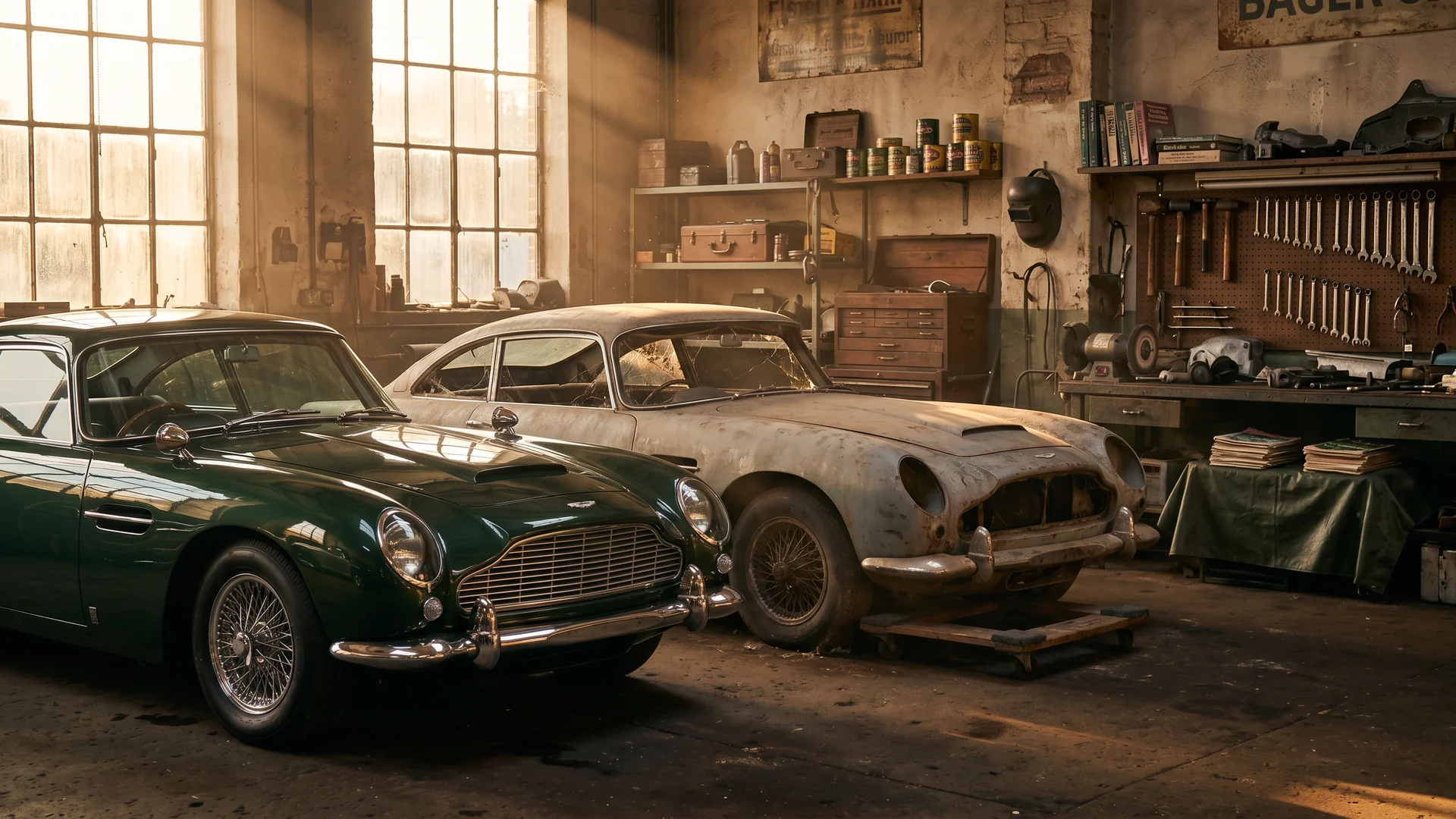
Restoring a classic car is a multi-year, multi-figure undertaking that rewards careful candidate selection, defined scope, disciplined documentation, and professional work where it counts.
Key Takeaways
- The most expensive mistake is starting with the wrong car; assess every candidate on structural integrity, completeness, and parts availability, in that order.
- Restorations split into three scopes with very different budgets: driver ($20,000 to $60,000), show ($60,000 to $150,000), and concours ($150,000 to $500,000 and beyond).
- Bodywork and paint typically consume 30 to 40 percent of the budget, with media blasting at $1,500 to $4,000 and a bare-metal respray at $8,000 to $20,000.
- Engine rebuild costs range widely, from $4,000 to $8,000 for a Chevrolet small-block V8 to $60,000 to $120,000 for a Ferrari Colombo V12.
- A Jaguar E-Type with rotted structure can need 800 to 1,200 hours of metalwork alone at $100 to $150 per hour from specialists like Classic Jaguar in Austin or XKs Unlimited in California.
- Frame-off restorations on mainstream classics realistically cost $60,000 to $120,000 and take 18 to 36 months, while high-end European marques run $200,000 to $500,000 over three to five years.
- Budget a minimum 25 percent contingency, document disassembly obsessively with photos and a parts spreadsheet, and never finance restoration with debt you cannot service from current income.
🌐 Also available in: Deutsch
The Ultimate Classic Car Restoration Guide: From Barn Find to Show Winner
Restoring a classic car is among the most ambitious, demanding, and ultimately rewarding undertakings in the entire automotive world. It is a journey measured not in weeks but in years, not in thousands of dollars but in tens or even hundreds of thousands. The process will test your patience, your budget, your relationships, and your sanity. Yet the result, a machine resurrected from rust and neglect, gleaming under concours lights or carving down a coastal road with the engine singing at full song, justifies every hour and every dollar for those with the passion, the patience, and the resources to see it through. This guide is your roadmap from the moment you first lay eyes on a dilapidated candidate to the champagne spray at its debut event, covering every phase of the restoration journey with practical detail earned through decades of collective experience in the restoration community. Whether you are considering your first project or your fifth, the principles that follow have been validated by countless restorations and will serve you well regardless of the marque, era, or condition of the car you choose to resurrect. The most important lesson, learned the hard way by too many enthusiasts, is that restoration rewards preparation and punishes haste at every stage of the process.
Choosing the Right Candidate: The Foundation of Everything
The single most expensive mistake in restoration is starting with the wrong car. A vehicle so corroded that it requires a complete rebody, or one missing irreplaceable trim, glass, and mechanical components, can consume a budget two or three times greater than a more intact starting point. Assess every candidate against three criteria, in descending order of importance: structural integrity, completeness, and parts availability. A 1965 Ford Mustang fastback with rusted floor pans but straight frame rails, solid torque boxes, and complete trim is a vastly better starting point than a superficially shiny car hiding bodged accident repairs and missing the rare GT equipment-group pieces that define its value. For European cars built with monocoque construction, Alfa Romeo Giulietta Spiders, Jaguar E-Types, Porsche 356s, early 911s, rust in the structural shell is an existential threat. A 1961 to 1974 Jaguar E-Type with rotted sills, floor pans, rear suspension mounting points, and the structural members that tie the front and rear subframes together can require 800 to 1,200 hours of metalwork alone at $100 to $150 per hour from a specialist shop like Classic Jaguar in Austin, Texas, or XKs Unlimited in California. Before you commit to a purchase, consult marque-specific restoration guides, the kind published by dedicated enthusiasts who have restored dozens of examples and documented every common failure point. Join owners’ forums and ask experienced restorers what they wish they had known before starting. If possible, pay a marque specialist $300 to $800 for a restoration-feasibility assessment that goes beyond a standard pre-purchase inspection to evaluate the car specifically as a restoration candidate. A few hundred dollars at this stage can save you tens of thousands later.
Setting the Scope: Driver, Show, or Concours
Restorations fall into three broad categories, and the decision you make here determines every subsequent choice about parts, processes, and budget. A driver restoration focuses on mechanical reliability and cosmetic presentability. The goal is a car that starts instantly, runs strongly, stops reliably, and looks good at twenty feet. Budget for most 1950s through 1970s cars in this category: $20,000 to $60,000. A show restoration aims for factory-correct appearance and excellent mechanical condition, suitable for regional shows and marque club events where knowledgeable judges will examine the car closely. The expectation is that the car presents as it did when new, with correct finishes, fasteners, and materials throughout. Budget: $60,000 to $150,000. A concours restoration pursues absolute perfection, often exceeding the standards the factory achieved when the car was built, with every nut, bolt, finish, and surface judged against a 100-point standard under fluorescent light at events like Pebble Beach, Amelia Island, or Villa d’Este. Budget: $150,000 to $500,000 and beyond, sometimes exceeding the car’s market value by a wide margin. Deciding your scope before the first bolt is turned prevents the all-too-common tragedy of a $120,000 restoration on a car worth $80,000, a mistake that no amount of passion can justify on a balance sheet. Write down your scope decision and refer to it whenever the temptation to upgrade or go deeper threatens to expand the project beyond its original parameters.
The Disassembly Phase: Documentation as Discipline
Disassembly is not merely the reverse of assembly. It is the foundation of a successful restoration, and the quality of your documentation at this stage will determine the ease or agony of every subsequent phase. Every component removed must be photographed from multiple angles, bagged and tagged with its location and orientation noted clearly, and stored systematically in labeled bins organized by system and subassembly. Use a digital camera or a modern smartphone with a capable camera to capture thousands of images. You will refer to them constantly during reassembly, and the photograph you did not take, of how that bracket was oriented, which side of the frame that wiring clip attached to, will be precisely the one you desperately need eighteen months later. Create a spreadsheet or a database tracking every part, its condition at disassembly, whether it will be restored or replaced, the source for replacement parts, and any notes that will help during reassembly. For complex wiring harnesses, label every single connector with masking tape and a Sharpie before you disconnect it, and photograph the routing before you remove it from the car. If you are restoring a car with intricate trim, a 1950s Cadillac with its abundance of chrome and stainless, a Facel Vega with its unique and irreplaceable brightwork, a coachbuilt Rolls-Royce with custom body hardware, consider creating a narrated video walkthrough of disassembly that you can consult later. This documentation habit pays enormous dividends when, two years into the project, you are staring at a coffee can of bolts and trying to remember which one secures the throttle linkage to the firewall. Organized restorers finish projects. Disorganized restorers sell unfinished projects at a loss. Be the organized one.
Body and Paint: The Largest Single Investment
Bodywork and paint typically consume 30 to 40 percent of the total restoration budget, and the quality of this work is the first thing anyone sees when they look at the finished car. The process begins with media blasting, using crushed glass, walnut shells, plastic media, or soda to strip old paint, filler, and rust from the body shell and removable panels. This costs $1,500 to $4,000 for a full body and panel set, and it reveals every flaw the old paint was hiding. Skilled metal fabrication follows: rust repair, accident-damage correction, panel replacement, and the painstaking process of aligning every gap to a standard the factory never achieved. This labor, at the rates commanded by premier restoration shops, Paul Russell and Company in Massachusetts, multiple Pebble Beach Best of Show winners, charges $120 to $175 per hour; Automotive Restorations Inc. in Connecticut operates in the same range; the revered shops of Southern California’s collector-car ecosystem are comparably priced, can run anywhere from $10,000 for minor rust repair on a solid car to $60,000 or more for extensive structural reconstruction. A complete bare-metal respray in a modern base-coat/clear-coat system runs $8,000 to $20,000 depending on the shop, the color, and the level of finish demanded. A period-correct single-stage paint job, appropriate for most pre-1970 cars and preferred by many purists for its depth and authenticity, costs comparably. Show-quality paint, wet-sanded to 3,000 grit or finer, buffed to a flawless mirror, with zero orange peel visible under any light, can double those figures. The best paint shops have waiting lists measured in months or years, and their work is worth the wait.
Engine and Drivetrain: The Mechanical Heart
Engine rebuilding is a precision craft that rewards expertise and punishes shortcuts. A full rebuild of a Chevrolet small-block V8 by a reputable shop like Jasper Engines or a regional marque specialist might cost $4,000 to $8,000 with quality components throughout. A Ferrari Colombo V12 rebuild from a shop like Patrick Ottis Company in Berkeley, California, or GTO Engineering in the United Kingdom runs $60,000 to $120,000, reflecting the complexity of 24 valves requiring precise adjustment, dual distributors, six Weber carburetors that must be synchronized across all twelve cylinders, and internal components machined to tolerances that demand exceptional skill. The transmission, differential, suspension, brakes, and steering system each demand similar attention appropriate to their complexity. For British sports cars, MGs, Triumphs, Austin-Healeys, early Jaguars, parts are plentiful and relatively affordable through long-established suppliers like Moss Motors, Victoria British, and the Roadster Factory. For pre-war cars or low-production European exotics with production runs in the dozens or low hundreds, parts may simply not exist and must be fabricated from scratch by a skilled machinist working from original drawings, surviving examples, or educated guesswork, adding thousands of dollars in bespoke fabrication costs for each unavailable component. The parts-availability question should be answered before you purchase the project car, not discovered during assembly when you are missing a piece that simply cannot be sourced.
Interior, Chrome, and the Finishing Details
Interior restoration can transform a car’s character more dramatically than any other single phase. A complete leather interior from a trimmer who understands the marque, such as Dave Pratt’s shop in Texas, long established as a go-to for Ferrari interiors, or Autos International for Porsche, costs $4,000 to $15,000 depending on the quality of materials and the complexity of the work. A 1950s American convertible with power seats, a complex multi-piece dashboard, yards of chrome and stainless trim, and a power-operated top mechanism might run toward the upper end of that range, while a simple British roadster with two seats, door panels, and minimal carpet might be toward the lower end. Chroming is an environmental and regulatory minefield, and the best shops, Advanced Plating in Nashville, Tennessee, widely considered among the finest in the country; Ogden Chrome in Utah; several specialist platers in Southern California, charge $2,000 to $8,000 for a full set of bumpers and trim pieces. The quality difference between show chrome and production chrome is immediately apparent: show chrome is deeper, more lustrous, and free of the microscopic imperfections visible in lower-grade work. For high-point restorations, the quality of chrome is judged under fluorescent light at close range, and inferior work is instantly apparent to trained eyes. Do not save money on chrome if you are building a show or concours car; the judges will see it, and you will regret it every time you look at your own bumpers.
Budget Reality and Timeline Honesty
Frame-off restorations on mainstream classics: a 1965 to 1970 Mustang, a Chevrolet Camaro of the same era, a Porsche 911 SC from the late 1970s, realistically cost $60,000 to $120,000 and take 18 to 36 months from disassembly to first drive. For high-end European marques, Ferrari, Maserati, Aston Martin, pre-war Alfa Romeo, budgets of $200,000 to $500,000 and timelines of three to five years are common and should be expected. The most expensive restorations in history, such as the multi-year, multi-million-dollar efforts performed on Ferrari 250 GTOs by marque specialists working to standards that exceed what the factory achieved in period, have exceeded $1 million in cost and required the better part of a decade. Every restoration encounters surprises: a cracked engine block hidden under decades of grime, collision damage concealed by thick filler, a wiring harness so brittle from heat and age that it crumbles in your hands when you try to move it. Budget a minimum 25 percent contingency above your initial estimate, and never finance a restoration with debt you cannot service from current income. Restoration is a labor of love, not a short-term profit strategy, and the restorers who finish projects and enjoy them are the ones who understand this from the beginning. As the saying goes among experienced restorers: you can have it fast, you can have it cheap, or you can have it right. Pick two. The third is not available at any price.
DIY versus Professional: Drawing the Line Wisely
Many enthusiasts handle disassembly, cleaning, parts sourcing, and minor mechanical work themselves, then send the body to a specialist and the engine to a professional builder. This hybrid approach can save $20,000 to $50,000 on a typical restoration while still ensuring that the most demanding, specialized work is performed by people who do it every day. However, certain tasks, final paint, final assembly of complex mechanical systems, interior trimming, and chrome plating, demand professional expertise to achieve show-quality results, and attempting them as a DIY project with inadequate equipment and experience almost always produces a result that disappoints. Know your limits honestly, and never attempt a procedure that, if botched, could ruin an irreplaceable component that cannot be sourced again at any price. The money you save by doing it yourself is meaningless if the result is not what you wanted and the part you destroyed cannot be replaced.
Post-Restoration: The Shakedown Period
A freshly restored car is not finished when it rolls out of the shop. It is simply assembled. The first 500 to 1,000 miles constitute the shakedown period, during which issues that were invisible during static assembly reveal themselves in operation: a coolant leak that only appears when the engine reaches full operating temperature, an electrical gremlin triggered by a specific combination of lights and accessories that was never tested, a driveline vibration at exactly 55 miles per hour that requires rebalancing the driveshaft or adjusting the pinion angle. Keep a logbook in the car and note every anomaly, however minor. Address issues methodically, one system at a time, rather than chasing symptoms across multiple systems simultaneously. Once the car proves itself reliable over several hundred miles of varied driving, consider entering it in a marque club concours or regional show, not necessarily with the expectation of winning, but to benefit from the scrutiny of experienced judges who will spot details you missed and provide feedback that improves the car. Restoration is not for the faint of heart or the light of wallet. But for those who undertake it with eyes wide open, who respect the craft and embrace the process rather than racing to the finish, the reward is not merely a car. It is a machine reborn, carrying forward a piece of automotive history that might otherwise have been lost to rust and time. The community of restorers, whether professional or amateur, is bound together by a shared understanding that what they do matters: that each car saved from the crusher, each engine brought back to life, each panel straightened and painted, represents a victory against entropy and a gift to the future. When you complete a restoration and drive your car for the first time, you join a fellowship of craftsmen and enthusiasts stretching back more than a century, and you understand, in a way that no spectator ever can, what it means to bring a machine back from the dead.
Frequently Asked Questions (FAQ)
How much does it cost to restore a classic car?
It depends on scope. A driver restoration runs $20,000 to $60,000, a show restoration $60,000 to $150,000, and a concours restoration $150,000 to $500,000 and beyond. High-end European marques like Ferrari or Aston Martin reach $200,000 to $500,000, and the most extreme efforts on cars like Ferrari 250 GTOs have exceeded $1 million.
How long does a classic car restoration take?
Frame-off restorations on mainstream classics such as a 1965 to 1970 Mustang, a Camaro, or a Porsche 911 SC realistically take 18 to 36 months from disassembly to first drive. High-end European marques like Ferrari, Maserati, and Aston Martin commonly require three to five years, while the most ambitious projects can take the better part of a decade.
What should I look for when buying a classic car to restore?
Assess every candidate against three criteria in descending order: structural integrity, completeness, and parts availability. Rust in a monocoque shell, as on a Jaguar E-Type or Porsche 356, is an existential threat. A solid but rusty-floored car beats a shiny one hiding bodged repairs or missing rare trim. Paying a specialist $300 to $800 for a feasibility assessment can save tens of thousands later.
What is the difference between a driver, show, and concours restoration?
A driver restoration focuses on mechanical reliability and looking good at twenty feet. A show restoration aims for factory-correct appearance and excellent condition for regional and club events. A concours restoration pursues absolute perfection, often exceeding factory standards, judged against a 100-point standard at events like Pebble Beach, Amelia Island, or Villa d'Este.
How much of the budget does bodywork and paint take in a classic car restoration?
Bodywork and paint typically consume 30 to 40 percent of the total restoration budget. Media blasting costs $1,500 to $4,000, metal fabrication can run from $10,000 to $60,000 or more, and a bare-metal respray costs $8,000 to $20,000. Show-quality paint, wet-sanded to 3,000 grit and buffed mirror-flawless, can double those figures.
Why is documentation so important during classic car disassembly?
Disassembly is the foundation of a successful restoration, and documentation quality determines how easy reassembly is. Photograph every component from multiple angles, bag and tag parts by location, label wiring connectors, and track everything in a spreadsheet. The photo you fail to take is the one you will desperately need eighteen months later. Organized restorers finish projects; disorganized ones sell them unfinished at a loss.
Which classic car parts and tasks should be left to professionals?
Final paint, final assembly of complex mechanical systems, interior trimming, and chrome plating demand professional expertise for show-quality results. Many enthusiasts handle disassembly, cleaning, parts sourcing, and minor mechanical work themselves, saving $20,000 to $50,000, then send the body and engine to specialists. Never attempt a procedure that, if botched, could ruin an irreplaceable component.
What happens after a classic car restoration is finished?
A freshly restored car is assembled, not finished. The first 500 to 1,000 miles are a shakedown period when hidden issues like coolant leaks, electrical gremlins, or a 55-mph driveline vibration reveal themselves. Keep a logbook, address problems methodically one system at a time, and once the car proves reliable, consider entering a marque club concours or regional show for judges' feedback.
More from Blog
The Future of Classic Car Collecting: Trends Shaping the Next Generation
The future of classic car collecting: why 2035 ICE bans spare existing cars, plus e-fuels, shifting demographics, electromods and fractional ownership…
Classic Car Insurance Guide: Protecting Your Vintage Investment
Classic car insurance guide: why agreed-value policies beat stated and actual cash value, how Hagerty, Grundy and Chubb compare, plus costs and covera…
Classic Car History Timeline: From Benz to the Modern Collector Era
Classic car history timeline from the 1886 Benz Patent-Motorwagen through coachbuilding, muscle cars and supercars to modern collectibles. Discover th…