Classic Car History Timeline: From Benz to the Modern Collector Era
Classic car history timeline from the 1886 Benz Patent-Motorwagen through coachbuilding, muscle cars and supercars to modern collectibles. Discover the icons.…
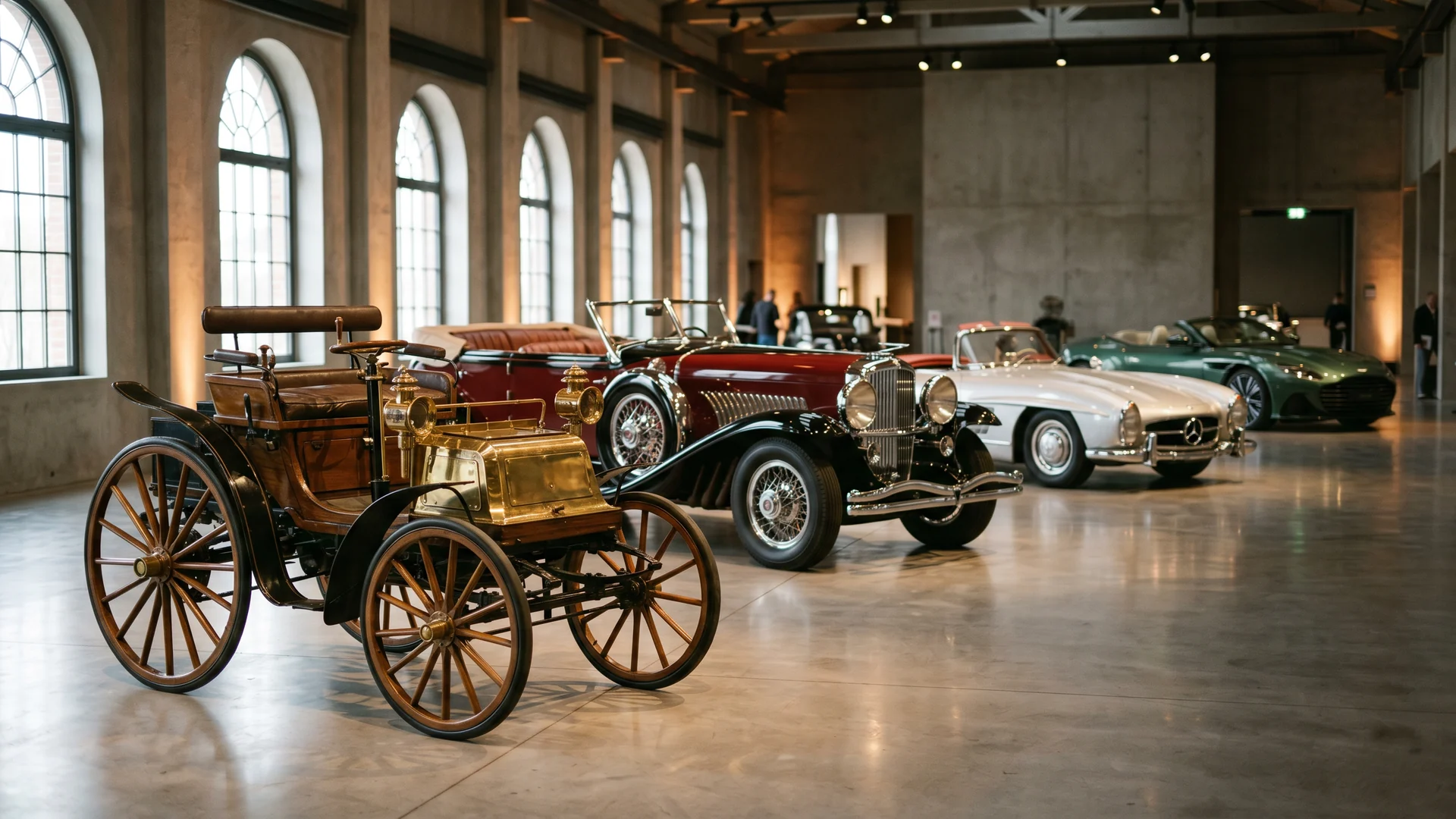
The classic car timeline runs from Karl Benz's 1886 Patent-Motorwagen through coachbuilding, post-war sports cars, muscle cars and supercars to today's instant modern classics.
Key Takeaways
- The automobile was born in 1886, when Karl Benz patented his three-wheeled Patent-Motorwagen in Mannheim and Daimler and Maybach fitted an engine to a carriage in Cannstatt near Stuttgart.
- In 1888 Bertha Benz drove 106 kilometers from Mannheim to Pforzheim, inventing brake linings via a cobbler and clearing a fuel line with her hatpin along the way.
- Ford's moving assembly line at Highland Park in 1913 cut Model T chassis assembly from 12.5 hours to 93 minutes and dropped the touring car price from 850 to 260 dollars.
- The interwar Golden Age (1919 to 1939) was the zenith of coachbuilding, producing icons like the 1936 Bugatti Type 57SC Atlantic and the Alfa Romeo 8C 2900B.
- Ferrari's 250 GTO, built in just 36 examples between 1962 and 1964, became the most valuable series-produced automobile in history.
- The muscle car era was ignited by the 1964 Pontiac GTO and ended almost overnight after the 1971 oil embargo, rising insurance costs and federal emissions rules.
- The 1966 Lamborghini Miura is regarded as the first supercar, a line that ran through the Ferrari F40 (the first production car past 200 mph) to the 1,001-horsepower 2005 Bugatti Veyron.
🌐 Also available in: Deutsch
The Classic Car History Timeline: From Horseless Carriage to Collectible Icon
The history of the automobile spans less than 140 years, and yet within that remarkably compressed timeline lies an epic narrative of technological revolution, social transformation, artistic achievement, industrial warfare conducted on a global scale, and the emergence of a culture of collecting and preservation that has elevated individual automobiles to the status of fine art. The classic car, the automobile elevated from mere transportation to object of desire, preservation, and collecting, traces its lineage through distinct eras, each one defined by the interplay of engineering advances, design philosophies, economic conditions, and cultural forces that shaped not only the cars themselves but the communities that formed around them. This timeline traces that evolution from the earliest days of the horseless carriage through the golden age of coachbuilding, the post-war sports-car boom, the muscle-car wars, the supercar emergence of the late twentieth century, and into the modern era where cars built within living memory are already recognized as the classics of tomorrow. Understanding this timeline is essential not merely for appreciating the individual cars but for grasping why certain models, certain eras, and certain marques command the values, the reverence, and the passionate following that they do. Every classic car is a product of its moment, shaped by the technology, the aesthetics, and the cultural assumptions of the society that created it, and the timeline reveals those connections with clarity and force.
The Pioneer Era: 1886 to 1918
The automobile was born, by the consensus of most historians, in 1886, a remarkable year in which two independent inventors working in different German cities created the first vehicles that were recognizably automobiles rather than motorized adaptations of existing carriages. Karl Benz patented his three-wheeled Patent-Motorwagen in Mannheim, a machine that was designed from its inception as a unified whole, with its single-cylinder engine, chassis, and body conceived as an integrated system. Independently and nearly simultaneously, Gottlieb Daimler and his collaborator Wilhelm Maybach fitted a high-speed internal-combustion engine to a carriage in Cannstatt, near Stuttgart, creating the first four-wheeled automobile. The Benz was arguably the more visionary design, a purpose-built automobile rather than an adapted carriage, and in 1888, Bertha Benz, Karl’s wife, an extraordinary figure whose contribution to automotive history has only recently received the recognition it deserves, completed the first long-distance automobile journey, driving 106 kilometers from Mannheim to Pforzheim with her two sons to demonstrate the practicality of her husband’s invention. Along the way, she invented brake linings by having a cobbler fit leather pads to the wooden brake blocks, and she unclogged a blocked fuel line with her hatpin, a demonstration of resourcefulness that every stranded motorist has channeled in the decades since.
France became the center of early automotive development, with Panhard et Levassor and Peugeot licensing the Daimler engine and beginning series production of automobiles. The Système Panhard, front-mounted engine driving the rear wheels through a sliding-gear transmission, with the engine in front, the passengers in the middle, and the driven wheels at the rear, established the fundamental architectural template that would dominate automobile design for the next century and beyond. The 1901 Mercedes 35 HP, designed by Wilhelm Maybach for Daimler-Motoren-Gesellschaft at the behest of the entrepreneur and diplomat Emil Jellinek, who named the car after his daughter Mercédès, is widely recognized as the first modern automobile. It introduced the pressed-steel chassis, the honeycomb radiator that made reliable engine cooling possible for the first time, the gate-change gearbox, and a low center of gravity achieved by placing the engine low in the frame, a complete departure from the high, unstable carriage-derived designs that preceded it.
In 1906, Rolls-Royce introduced the 40/50 HP, which would become immortalized as the Silver Ghost after the publicity-generating 1907 15,000-mile reliability trial that established the company’s reputation for standards of engineering and quality that no other manufacturer could match. The Silver Ghost was not the fastest car of its era, nor the most powerful, nor the most innovative in any single dimension. It was simply the best-built car in the world, with a level of attention to materials, machining, and assembly that created an experience of mechanical refinement that felt almost supernatural to buyers accustomed to the vibration, noise, and unreliability of lesser automobiles. In 1908, Henry Ford introduced the Model T, a car that was not designed to be the best but to be the most accessible. The moving assembly line, implemented at Ford’s Highland Park factory in 1913, reduced the time required to assemble a Model T chassis from 12.5 hours to 93 minutes, and the price of a Model T touring car fell from $850 to $260 over the course of the car’s production run. By 1927, when the last Model T rolled off the line, 15 million had been produced, a record that stood until the Volkswagen Beetle surpassed it in 1972.
Bugatti, founded in 1909 by the Italian-born, French-naturalized Ettore Bugatti in the Alsatian town of Molsheim, then part of Germany, now firmly French, produced the diminutive, jewel-like Type 13, which won the 1921 Voiturette Grand Prix at Brescia and gave the model its enduring nickname. The Type 13 established Bugatti’s philosophy of combining engineering excellence with aesthetic beauty, a philosophy that would reach its ultimate expression in the Type 35 Grand Prix car and the Type 57 Atlantic of the 1930s.
The Golden Age: 1919 to 1939
The interwar period represents what many knowledgeable observers consider the absolute zenith of the coachbuilder’s art, an era when the automobile chassis served as the canvas upon which independent artists in wood, metal, leather, and paint created bodies of breathtaking individuality and beauty. The great coachbuilding firms, Barker, Hooper, H.J. Mulliner, Park Ward, and James Young in Britain; Figoni et Falaschi, Saoutchik, Franay, Labourdette, and Chapron in France; Castagna and Touring in Italy; Murphy, Bohman and Schwartz, Derham, and Brewster in the United States, created automobile bodies that were nothing less than works of applied art, each one tailored to the tastes, the requirements, and the social station of its first owner.
The 1920s saw Bugatti introduce the Type 35 in 1924, a car that would go on to win over 1,000 races during its career, a record unmatched by any other racing car in history, and that established the template for the Bugatti racing cars that would follow. The Bentley 3 Litre, introduced in 1921, and its successors the 4½ Litre and Speed Six, driven by the wealthy and fearless young men known collectively as the Bentley Boys, won the 24 Hours of Le Mans in 1924, 1927, 1928, 1929, and 1930, establishing a British racing tradition at La Sarthe that endures to this day. The 1930 Mercedes-Benz 770, known as the Grosser Mercedes, established the template for the state limousine of staggering presence and cost that would define the upper limits of the automobile for decades.
The 1930s produced cars of extraordinary beauty and ever-increasing mechanical sophistication. The 1934 Citroën Traction Avant pioneered front-wheel drive and unitary body construction for mass-produced vehicles, innovations that would not become universal in the industry for another half-century. The Chrysler Airflow of the same year introduced aerodynamic streamlining to the American market, though its radical styling, a complete departure from the upright, radiator-forward aesthetic that defined the era, was too advanced for contemporary tastes and the car was a commercial failure that taught Detroit a cautionary lesson about the pace at which public taste evolves. The Bugatti Type 57SC Atlantic of 1936, with its riveted dorsal seam and its teardrop coupe profile designed by Jean Bugatti, remains arguably the most beautiful and certainly one of the most valuable cars ever built, a machine that transcends its function to become sculpture.
The Alfa Romeo 8C 2900B, built from 1937 to 1939 with voluptuous Touring Superleggera bodywork draped over a supercharged 2.9-liter straight-eight engine, represented the absolute pinnacle of pre-war sports-car engineering, combining prodigious performance with a level of aesthetic refinement that has never been surpassed. The 1939 Lagonda V12, designed under the leadership of W.O. Bentley after his departure from the company that still bore his name, was among the finest British cars of the immediate pre-war period and a demonstration that Bentley had lost none of his engineering genius in the transition from one company to another.
Post-War Renaissance: 1945 to 1965
The post-war period witnessed the emergence of the production sports car as a distinct and vibrant market segment. Jaguar’s XK120, launched in 1948 with a 3.4-liter dual-overhead-camshaft straight-six engine and voluptuous bodywork styled by Malcolm Sayer, an aerodynamicist who applied aircraft-design principles to automobile styling with breathtaking results, was the fastest production car in the world at its launch at 120 miles per hour, hence the name, and it established Jaguar’s enduring reputation for combining speed, beauty, and relative affordability in a package that no competitor could match. The Mercedes-Benz 300SL Gullwing of 1954, derived directly from the W194 racing car that had won the 1952 Carrera Panamericana and the 24 Hours of Le Mans, featured innovative direct fuel injection, upward-opening gullwing doors necessitated by the tall sills of its space-frame chassis, and a top speed exceeding 160 miles per hour that made it the fastest production car of its era.
In Italy, Enzo Ferrari: a former Alfa Romeo racing driver and team manager who had started his own company in 1947 after the war, was building the legend that would come to define the ultimate in automotive desirability. The 1947 Ferrari 125 S, powered by a 1.5-liter V12 designed by the brilliant engineer Gioacchino Colombo, was the first car to bear the Ferrari name. The 250 series that followed, the 250 MM, the 250 GT Tour de France, the 250 GT SWB (Short Wheelbase) Berlinetta, the 250 GT Lusso, and the ultimate expression of the line, the 250 GTO, established Ferrari as the dominant force in GT racing and the most coveted marque in collector circles worldwide. The GTO’s production run of 36 cars between 1962 and 1964 has become, through the alchemy of racing success, design excellence, and extreme rarity, the most valuable series-produced automobile in history.
In America, the Chevrolet Corvette debuted in 1953 as a fiberglass-bodied six-cylinder roadster that was more a styling exercise than a serious sports car. It was the 1955 introduction of the small-block V8, an engine designed under the leadership of Ed Cole, Zora Arkus-Duntov, and a team of engineers who created what would become the most versatile and widely used performance engine in American history, that transformed the Corvette into a genuine sports car. The Ford Thunderbird, introduced in 1955 as Ford’s response to the Corvette but conceived from the beginning as a personal luxury car rather than an outright sports car, evolved through multiple generations to define a uniquely American automotive genre.
The Muscle Car Era: 1964 to 1972
The muscle car era, ignited by the 1964 Pontiac GTO: essentially a Tempest LeMans intermediate coupe with a 389-cubic-inch V8 that Pontiac’s leadership had slipped past General Motors’ corporate prohibition on large engines in intermediate cars by offering it as an option package rather than a separate model, defined American automotive performance for a generation and created an entire category of vehicles that would become among the most collectible American cars ever produced. The formula was brilliantly simple and devastatingly effective: an intermediate-sized car with the largest available V8, optimized for straight-line acceleration, priced within reach of young buyers. The Ford Mustang, conceived by the visionary executive Lee Iacocca and launched in April of 1964 to a reception that exceeded even Ford’s most optimistic projections, launched the pony car segment and sold an astonishing 418,000 units in its first year of production.
By 1968 through 1970, the muscle-car wars reached their absolute zenith in a crescendo of displacement that seemed to escalate with every model year. The Dodge Charger R/T with the 440 Magnum and the near-mythical 426 Hemi. The Chevrolet Chevelle SS 454 LS6, officially rated at 450 horsepower but widely understood within the industry to be significantly underrated to appease insurance companies. The Plymouth Road Runner 426 Hemi and the homologation-special Hemi ‘Cuda that would become, decades later, the most valuable American muscle cars in existence. The Buick GSX Stage 1 with its monstrous 510 pound-feet of torque from a 455-cubic-inch V8. These cars delivered levels of straight-line performance that American manufacturers would not match for over three decades. The 1971 oil embargo, soaring insurance premiums for high-performance vehicles, and the first wave of federal emissions regulations killed the muscle-car era almost overnight. By 1973, the Mustang II, a modest Pinto-based economy car, symbolized the retreat from performance that would define the American industry for the remainder of the decade.
The Supercar Emergence: 1966 to 2005
While Detroit was building muscle cars for the drag strip, Europe was creating the supercar for the open road. The 1966 Lamborghini Miura, with its transversely mounted 3.9-liter V12 and breathtaking Bertone body designed by the young Marcello Gandini, is universally regarded as the first supercar, a mid-engine, two-seat exotic whose layout, proportions, and philosophy established a template that every supercar since has followed. The 1971 Lamborghini Countach prototype, the LP500, and the production LP400 that followed in 1974, with its scissor doors and origami-wedge shape that looked like nothing else on the road, defined the supercar aesthetic for an entire generation.
The 1987 Porsche 959 was a technological tour de force that redefined what a road car could be: twin-turbocharged 2.85-liter flat-six, all-wheel drive with variable torque distribution, electronically adjustable ride height and damping, magnesium wheels with hollow spokes containing tire-pressure sensors, and a top speed of 197 miles per hour. The Ferrari F40, launched in the same year to celebrate Enzo Ferrari’s 40th anniversary as a constructor, was the last car personally approved by the founder before his death in 1988. Twin-turbocharged V8, composite body panels, no carpet, no door handles, no sound deadening, no concessions to comfort of any kind, and a top speed of 201 miles per hour, the first production car to breach the 200-mile-per-hour barrier.
The 1993 McLaren F1, designed by Gordon Murray with a central driving position, a carbon-fiber monocoque, a naturally aspirated 6.1-liter BMW V12 producing 627 horsepower, and a gold-foil-lined engine bay, set a production-car speed record of 240.1 miles per hour that stood for over a decade. The 2005 Bugatti Veyron, with its quad-turbocharged W16 engine producing 1,001 horsepower, demonstrated that the pursuit of ever-higher performance was alive and accelerating. Each of these cars, once dismissed as merely “used exotics,” is now recognized as a modern classic whose values reflect their historical significance. The timeline continues to be written with every new generation of automobiles, and the cars being produced today are already destined to become the classics that future generations will collect, preserve, and celebrate. From the Benz Patent-Motorwagen of 1886 to the hybrid hypercars of the 2020s, the history of the automobile is a continuous narrative of human ingenuity, ambition, and the unquenchable desire to go faster, farther, and with greater style than ever before. Understanding that history enriches every interaction with the classic cars we collect, drive, and admire today.
Frequently Asked Questions (FAQ)
When and where was the first classic car, the Benz Patent-Motorwagen, invented?
The automobile was born in 1886, when Karl Benz patented his three-wheeled Patent-Motorwagen in Mannheim. The same year, Gottlieb Daimler and Wilhelm Maybach independently fitted a high-speed internal-combustion engine to a carriage in Cannstatt, near Stuttgart, creating the first four-wheeled automobile.
What did Bertha Benz do that made automotive history?
In 1888, Bertha Benz completed the first long-distance automobile journey, driving 106 kilometers from Mannheim to Pforzheim with her two sons. Along the way she invented brake linings by having a cobbler fit leather pads to the brake blocks and unclogged a blocked fuel line with her hatpin.
Why is the Ferrari 250 GTO considered the most valuable classic car?
The Ferrari 250 GTO is the most valuable series-produced automobile in history because of its rarity, racing success and design excellence. Only 36 cars were built between 1962 and 1964, and that extreme scarcity combined with Ferrari's dominance in GT racing made the model supremely coveted in collector circles worldwide.
What is considered the first supercar?
The 1966 Lamborghini Miura is universally regarded as the first supercar. With a transversely mounted 3.9-liter V12 and a Bertone body designed by the young Marcello Gandini, its mid-engine, two-seat exotic layout, proportions and philosophy established a template that every supercar since has followed.
What started and ended the American muscle car era?
The muscle car era was ignited by the 1964 Pontiac GTO, an intermediate coupe fitted with a 389-cubic-inch V8 offered as an option package. It ended almost overnight after the 1971 oil embargo, soaring insurance premiums for high-performance vehicles and the first federal emissions regulations.
Which classic car was the first to reach 200 miles per hour?
The Ferrari F40 was the first production car to breach the 200-mile-per-hour barrier, with a top speed of 201 mph. Launched in 1987 to mark Enzo Ferrari's 40th anniversary as a constructor, it was the last car personally approved by the founder before his death in 1988.
What made the 1901 Mercedes 35 HP the first modern automobile?
The 1901 Mercedes 35 HP, designed by Wilhelm Maybach and named after Emil Jellinek's daughter Mercedes, introduced the pressed-steel chassis, the honeycomb radiator that made reliable cooling possible, the gate-change gearbox and a low center of gravity, breaking from the high, unstable carriage-derived designs that preceded it.
How fast was the Jaguar XK120 and why is it significant?
Launched in 1948, the Jaguar XK120 was the fastest production car in the world at 120 miles per hour, which gave the car its name. Powered by a 3.4-liter dual-overhead-camshaft straight-six and styled by aerodynamicist Malcolm Sayer, it established Jaguar's reputation for combining speed, beauty and relative affordability.
More from Blog
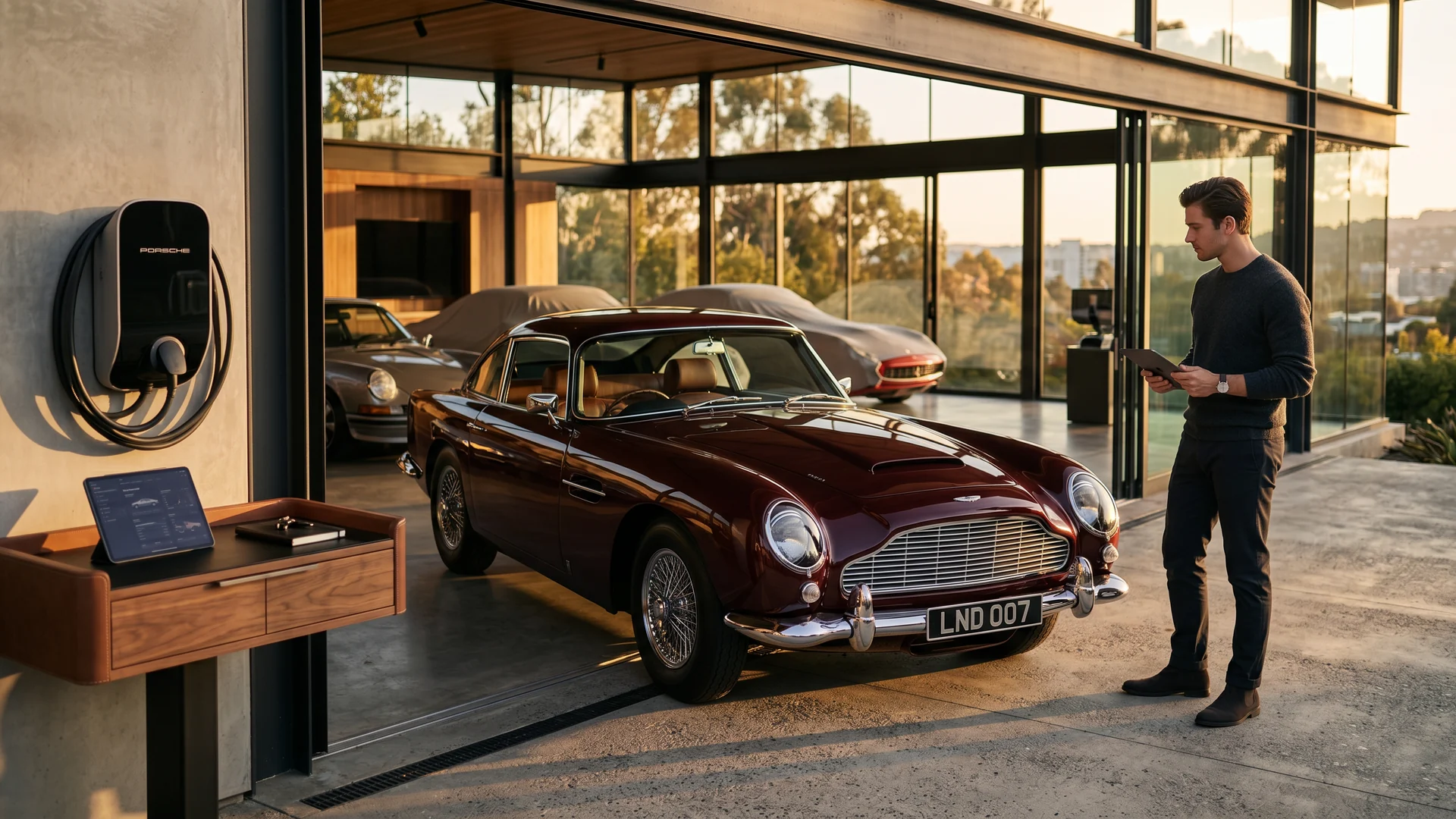
The Future of Classic Car Collecting: Trends Shaping the Next Generation
The future of classic car collecting: why 2035 ICE bans spare existing cars, plus e-fuels, shifting demographics, electromods and fractional ownership…
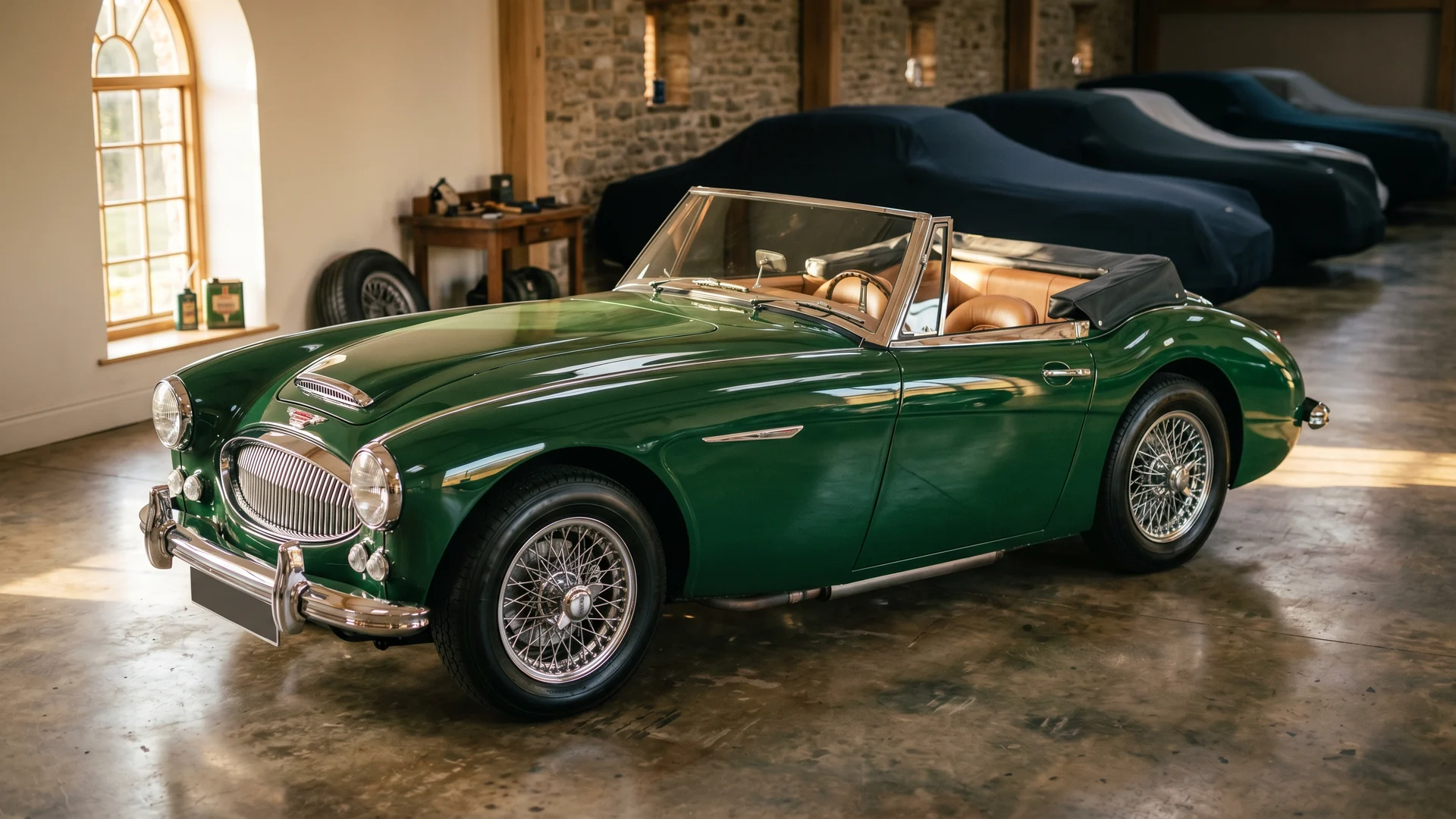
Classic Car Insurance Guide: Protecting Your Vintage Investment
Classic car insurance guide: why agreed-value policies beat stated and actual cash value, how Hagerty, Grundy and Chubb compare, plus costs and covera…
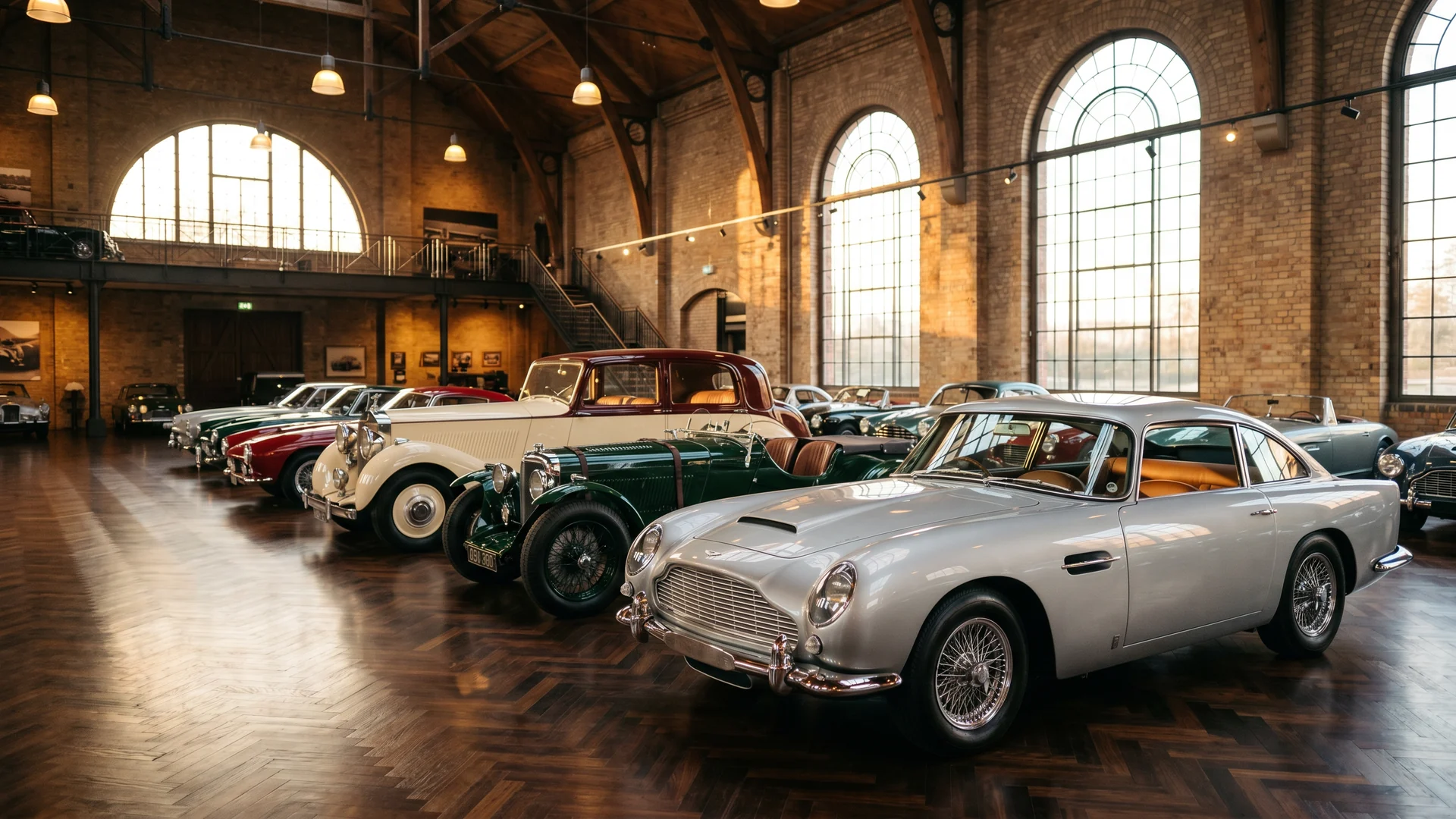
Famous Classic Car Collections: The World’s Most Extraordinary Automotive Assemblies
Explore the world’s most famous classic car collections, from Ralph Lauren and the Mullin and Petersen museums to the record-setting Schlumpf Co…