Famous Classic Car Collections: The World’s Most Extraordinary Automotive Assemblies
Explore the world’s most famous classic car collections, from Ralph Lauren and the Mullin and Petersen museums to the record-setting Schlumpf Collection.…
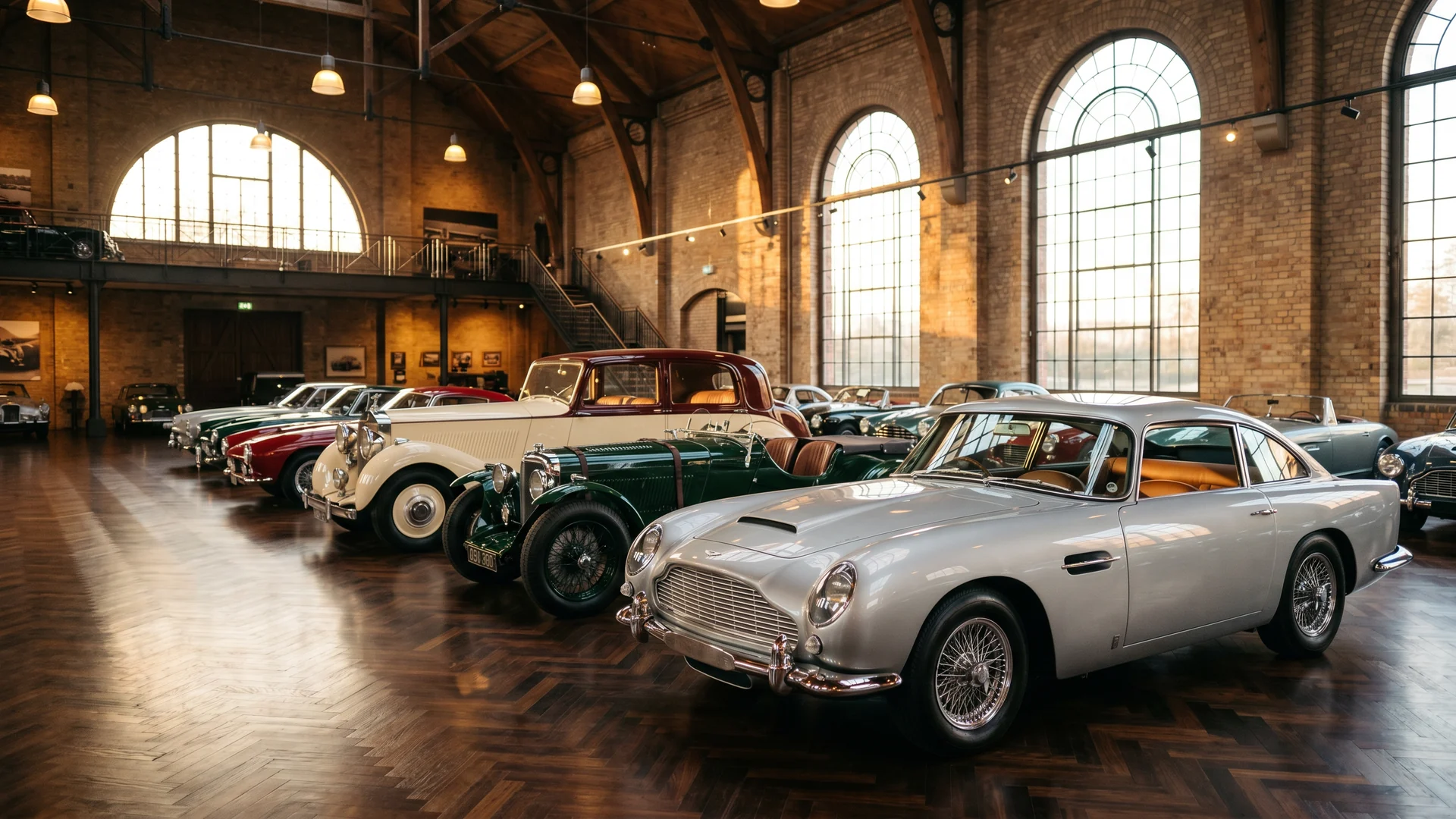
The world's most extraordinary classic car collections include Ralph Lauren's private assemblage, the Mullin and Petersen museums, the Revs and Simeone foundations, and Europe's Schlumpf Collection, the largest on earth.
Key Takeaways
- Ralph Lauren's roughly 60-car collection in Westchester County, New York, is widely regarded as the finest private assemblage on earth, anchored by a 1938 Bugatti Type 57SC Atlantic, a 1962 Ferrari 250 GTO, and a 1954 Ferrari 375 Plus that won Le Mans.
- The Mullin Automotive Museum in Oxnard, California, focuses on French Art Deco coachbuilders and centers on the 1936 Bugatti Type 57SC Atlantic (chassis 57374), acquired by Peter Mullin in 2010 for a reported $30 to $40 million.
- The Petersen Automotive Museum in Los Angeles reopened after a $125 million renovation in 2015; its Vault stores over 250 cars, and its strengths are California hot rods, Hollywood cars, and competition machines like the 1939 Porsche Type 64.
- Miles Collier's Revs Institute in Naples, Florida, holds about 130 cars organized into four galleries and keeps them as operating artifacts, supported by the Revs Digital Library of millions of digitized automotive documents.
- Dr. Frederick Simeone's Philadelphia museum houses over 75 racing sports cars and runs Demo Days where staff actually drive them; its centerpiece is the 1964 Shelby Cobra Daytona Coupe (CSX2287) that won the 1965 FIA World Sportscar Championship.
- The Schlumpf Collection in Mulhouse, France, is the largest in the world, with over 400 cars including 122 Bugattis and two of the six Bugatti Royales ever built.
- The Sultan of Brunei's collection of over 7,000 cars is the largest private automobile collection on earth, while the Mercedes-Benz Museum in Stuttgart displays 160 vehicles including the 1886 Benz Patent-Motorwagen, the very first automobile.
🌐 Also available in: Deutsch
Famous Classic Car Collections: The World’s Greatest Assemblages of Automotive Art
Behind the auction records that dominate headlines, the concours winners that appear on magazine covers, and the private transactions that fuel the collector-car market at its highest level lie the collections that preserve, curate, and celebrate automotive history for current and future generations. These assemblages, some housed in architecturally significant museums open to the public, others held in strictly private facilities accessible only to invited guests, represent the cumulative passion, the refined taste, and in many cases the extraordinary financial resources of individuals, families, and institutions who have dedicated themselves to safeguarding the world’s most significant automobiles. This article surveys the most important car collections on earth, exploring what they contain, how they were assembled over decades of acquisitive passion, and what makes each of them extraordinary in its own distinctive way. The collections described below span continents and centuries, from the earliest surviving automobiles to the hypercars of the modern era, and together they form a distributed archive of automotive history that is irreplaceable. Each collection reflects the personality and the priorities of its creator: some emphasize beauty above all else, some focus on technical significance and engineering milestones, and others seek to document the full breadth of a particular marque or era. Together, they ensure that the most significant automobiles ever built will survive to inform and inspire future generations.
The Ralph Lauren Collection: American Elegance, Universally Admired
Ralph Lauren’s collection of automobiles, housed in a purpose-built, climate-controlled facility in New York’s Westchester County, is widely regarded by connoisseurs and museum professionals alike as the finest private assemblage of automobiles in the world, a judgment that reflects not merely the individual quality of the cars but the coherence and discernment of the curatorial vision that binds them together. The collection’s defining characteristic is not its volume, though at approximately 60 cars it is substantial by any standard. It is the almost impossibly refined and consistent curatorial eye that Lauren has brought to bear, selecting each car with the same sensibility that built one of the world’s most influential fashion empires. Every car in the collection is extraordinary in its own right, and every car is presented in flawless condition on white-tiled floors under museum-quality lighting that treats each automobile as the sculpture it deserves to be.
The collection’s crown jewels are among the most significant automobiles in existence. A 1938 Bugatti Type 57SC Atlantic, one of only two surviving examples of the four built, its teardrop coupe body designed by Jean Bugatti and its riveted dorsal seam running from windshield to tail representing perhaps the most beautiful single detail in all of automotive design, anchors the collection at a level of significance that few other collections can approach. A 1930 Mercedes-Benz SSK with dramatic coachwork by Count Trossi, its sweeping fenders and impossibly long hood creating a silhouette of predatory elegance. A 1958 Ferrari 250 Testa Rossa, the pontoon-fendered racing barchetta that dominated international sports-car racing in the late 1950s and remains one of the most beautiful and desirable Ferraris ever built. A 1962 Ferrari 250 GTO, the car that defines the ultimate in automotive collectibility across all marques and eras. And a 1954 Ferrari 375 Plus, the V12-powered endurance racer that won the 24 Hours of Le Mans outright in 1954, driven by José Froilán González and Maurice Trintignant. The Lauren collection has been exhibited at the Museum of Fine Arts in Boston in 2005 and at the Musée des Arts Décoratifs in Paris in 2011, confirming its status as a body of work recognized and respected by the highest levels of the art establishment, a validation that the automobile-as-art argument has never received more convincingly.
The Mullin Automotive Museum: A Temple to French Art Deco
Peter Mullin, who passed away in September of 2023, assembled over the course of his lifetime what is arguably the most comprehensive, focused, and breathtakingly beautiful collection of French automobiles from the Art Deco era ever created by a single individual. The Mullin Automotive Museum, housed in a modern facility in Oxnard, California, is a temple to the artistry, craftsmanship, and sheer aesthetic ambition of the French coachbuilders, Figoni et Falaschi, Saoutchik, Chapron, Labourdette, Franay, and others, who transformed the automobile from a means of transportation into rolling sculpture during the golden age of French automotive design between the two World Wars.
The museum’s indisputable centerpiece is the 1936 Bugatti Type 57SC Atlantic, chassis 57374, the former Williamson Atlantic, acquired by Mullin in 2010 for a price widely reported to be between $30 and $40 million. This car, with its riveted dorsal seam, its teardrop profile, and its supercharged 3.3-liter straight-eight engine, is one of the most beautiful and significant automobiles in the world, and its presence alone would justify a pilgrimage to Oxnard. But the Mullin collection extends far beyond any single car. A 1938 Hispano-Suiza H6B Dubonnet Xenia, a one-off aerodynamic coupe built for the aperitif magnate André Dubonnet, is a vision of streamlined Art Deco elegance. A 1939 Delahaye 165 Cabriolet, one of very few examples of its type, represents the collaboration between the French manufacturer and the Figoni et Falaschi coachworks at its most refined. Multiple Talbot-Lago T150-C-SS coupes, the famed “Teardrop” or “Goutte d’Eau” models with their fully enveloping fenders and impossibly elegant proportions, are represented in the collection in numbers that no other museum can match. And a comprehensive survey of Bugattis spanning the marque’s entire history from the earliest Brescias to the ultimate Type 57s provides context for the Atlantic.
The Mullin’s 1937 Delahaye 145 Franay Cabriolet, one of only two 4.5-liter V12 Delahayes built to challenge the dominant German racing teams in international competition, is historically significant beyond its considerable beauty. This car won the 1938 Million Franc Prize by breaking multiple speed records at the Montlhéry autodrome near Paris, a feat that earned it a place in French motorsport history entirely separate from its aesthetic qualities. The museum also houses the Schlumpf Reserve Collection of unrestored Bugattis, acquired by Peter Mullin from the Cité de l’Automobile in Mulhouse, France, providing scholars and restorers with untouched reference examples that document exactly how these cars were built.
The Petersen Automotive Museum: Los Angeles’s Cathedral of Car Culture
Following a comprehensive $125 million renovation completed in 2015, the Petersen Automotive Museum on Wilshire Boulevard in Los Angeles, occupying a full block of the Miracle Mile museum district, has been physically and programmatically transformed into one of the world’s most dynamic, visually striking, and intellectually ambitious automotive museums. The building’s exterior, wrapped in a flowing stainless-steel ribbon façade designed by the architectural firm Kohn Pedersen Fox, signals the institution’s aspiration to be recognized alongside the neighboring Los Angeles County Museum of Art and the other cultural institutions that define the Miracle Mile. The museum’s three floors of gallery space host rotating exhibitions that place automobiles in their cultural, artistic, and technological contexts. The Vault, presented in partnership with Hagerty, is a guided tour through the museum’s basement storage facility where over 250 cars are kept, ranging from a 1925 Rolls-Royce Phantom I Aerodynamic Coupe to a 2006 Ferrari 248 F1 driven by Michael Schumacher. The Vault experience changes regularly as cars are rotated between storage and the public galleries, meaning no two visits are identical.
The Petersen’s collection is strongest in three areas that reflect its Los Angeles location and its institutional history. American hot rods, customs, and the uniquely Californian car culture that emerged from the dry lakes, the drag strips, and the custom shops of post-war Southern California are represented in depth. Hollywood cars, the 1989 Batmobile from Tim Burton’s film, the DeLorean Time Machine from Back to the Future, Magnum P.I.’s Ferrari 308 GTS, and a rotating selection of vehicles that have starred in film and television, draw visitors who might never otherwise set foot in an automotive museum. And significant competition cars, including a 1939 Porsche Type 64, the car widely recognized as the direct predecessor to all Porsche sports cars, one of only three built for the planned Berlin-to-Rome race that was canceled by the outbreak of war.
The Revs Institute: Scholarship in Naples
Miles Collier’s Revs Institute in Naples, Florida, takes a distinctively scholarly approach to the automobile that sets it apart from every other major collection. Rather than emphasizing beauty or rarity for their own sake, the Revs Institute focuses on cars that represent significant, often pivotal advancements in automotive technology and engineering, cars that changed the direction of the automobile’s evolution in meaningful ways. The collection of approximately 130 automobiles is organized into four thematic galleries: Vitesse, exploring the pursuit of speed; Porsche, Designed to Excel, tracing the engineering-driven evolution of the most successful sports-car manufacturer in history; Revs, The Automobile as Art, acknowledging the aesthetic dimension of automotive design; and Automobility, examining the social and cultural impact of the automobile. Critically, the cars at Revs are not static museum exhibits. They are maintained as operating artifacts, they are driven regularly, either on the roads around Naples or on the institute’s own test track, and they are studied by scholars who have access to the institute’s extraordinary library and digital resources. The Revs Digital Library, providing open online access to millions of digitized automotive photographs, documents, and period publications, is a resource of international scholarly importance.
Highlights of the Revs collection include a 1914 Peugeot L45 Grand Prix car, the first car to win a Grand Prix with a dual-overhead-camshaft, four-valve-per-cylinder engine, the fundamental architecture that would come to define the modern high-performance engine and that is present in nearly every high-performance car on sale today. A 1925 Bugatti Type 35, the most successful racing car in history with over 1,000 race victories to its credit during its competition career. A 1939 Alfa Romeo 8C 2900B, the supercharged straight-eight masterpiece that represented the absolute pinnacle of pre-war sports-car engineering. A 1963 Ferrari 250 GTO, chassis 4293 GT, with extensive period racing history that connects the car directly to the golden age of GT racing. And a 1970 Porsche 917K in the iconic Gulf Oil livery, the car that gave Porsche its first overall victory at the 24 Hours of Le Mans.
The Simeone Foundation: Driving History
Dr. Frederick Simeone’s museum in Philadelphia houses one of the world’s greatest and most focused collections of racing sports cars, with over 75 automobiles spanning from a 1909 American Underslung to a 1993 Porsche 962. The collection’s defining philosophy is encapsulated in the museum’s signature program, Demo Days, held on a three-acre paved lot behind the museum building. On scheduled Demo Days, museum staff actually start, warm up, and drive selected cars from the collection, Cobra Daytona Coupes, Alfa Romeo 8C 2900s, Bugatti Type 57G “Tank” Le Mans cars, and other machines that most museums would never allow to turn a wheel, demonstrating their capabilities and their sounds to visitors who experience these cars as living, breathing machines rather than static displays behind velvet ropes.
The collection’s centerpiece is a 1964 Shelby Cobra Daytona Coupe, chassis CSX2287, the first of only six built and the car that won the 1965 FIA World Sportscar Championship for the United States, making it one of the most historically significant American competition cars ever constructed and arguably the single most important American racing car in existence. Supporting it are a 1954 Ferrari 375 MM, a 1936 Bugatti Type 57G “Tank,” a 1937 Alfa Romeo 8C 2900A, a 1970 Porsche 917LH in long-tail Le Mans configuration, and dozens of other significant competition cars spanning the entire history of motorsport. The Simeone Foundation’s commitment to operating its cars rather than merely displaying them makes it unique among major collections and provides a connection to the sensory experience of these machines that photographs and static displays simply cannot convey.
European Institutions: The Old World’s Treasures
The Musée National de l’Automobile in Mulhouse, France, better known to enthusiasts as the Schlumpf Collection, is the largest automobile collection in the world. Housed in a vast former textile mill, the collection contains over 400 cars including 122 Bugattis, the largest concentration of Bugattis anywhere on earth, with examples spanning the marque’s entire history from the earliest Type 13 Brescias to the ultimate Type 57S Atlantics and Type 41 Royales. The Schlumpf brothers, Fritz and Hans, textile magnates who secretly amassed the collection over decades before fleeing France in 1977 amid the collapse of their business empire, left behind a collection so significant that the French government classified it as a historic monument and converted the mill into a national museum. The Bugatti Royales, of which only six were ever built and two reside at Mulhouse, are cars of staggering scale and presence, with 12.7-liter straight-eight engines and bodywork of imperial grandeur.
The Mercedes-Benz Museum in Stuttgart, Germany, housed in a spiraling double-helix building designed by UN Studio near the Untertürkheim factory where the company has built its cars for over a century, presents the intertwined histories of the automobile and the company across nine levels of exhibition space. The collection of 160 vehicles and 1,500 supporting exhibits includes the 1886 Benz Patent-Motorwagen, the very first automobile; the 1954 and 1955 W196 Grand Prix cars in both open-wheel and streamlined Monza configurations; the 1955 300SLR Uhlenhaut Coupé, now the most valuable car in history; and a comprehensive survey of every significant model the company has produced across its storied history. The Museo Ferrari, split between the Enzo Ferrari Museum in Modena and the Ferrari Museum in Maranello adjacent to the factory itself, tells the story of the most evocative name in automotive history through the cars that defined each era.
Private Collections of Global Significance
Beyond the museums and institutions that welcome the public, private collections of enormous significance exist worldwide behind closed doors. The Sultan of Brunei’s collection, estimated at over 7,000 cars including hundreds of bespoke, one-off Rolls-Royces, Ferraris, Aston Martins, and other exotica built to the royal family’s specifications over decades, is the largest private automobile collection on earth, though its condition is reported to be variable and its future uncertain. The Royal Family of Qatar’s collection, meticulously maintained in a climate-controlled facility, is believed to include many of the world’s most significant Ferraris alongside important examples from every major marque. Bernie Ecclestone’s collection of historic Grand Prix cars, focused on the machines he owned and campaigned during his decades as a team owner and Formula One impresario, includes many of the most important racing cars ever built.
These collections, whether public or private, institutional or personal, share a common and vitally important purpose. They preserve the physical artifacts of automotive history against the ravages of time, neglect, and changing tastes, ensuring that future generations, our children, our grandchildren, and the scholars and enthusiasts of centuries yet to come, will be able to study, admire, and understand the machines that shaped the twentieth century and continue to define humanity’s relationship with motion, design, and engineering excellence. Each collection, in its own way, is an act of stewardship and a statement of faith that the objects worth preserving today will still be worth understanding tomorrow. That faith has been vindicated again and again as museums and private collectors have safeguarded cars that might otherwise have been scrapped, forgotten, or destroyed, and in doing so they have preserved not just metal and rubber and leather but the stories, the ingenuity, and the ambition that those materials embody.
Frequently Asked Questions (FAQ)
What is the most famous private classic car collection in the world?
Ralph Lauren's collection is widely regarded by connoisseurs and museum professionals as the finest private assemblage of automobiles in the world. Housed in a climate-controlled facility in Westchester County, New York, its roughly 60 cars are prized less for volume than for an exceptionally refined and consistent curatorial eye.
What is the centerpiece of the Mullin Automotive Museum?
The Mullin Automotive Museum's centerpiece is the 1936 Bugatti Type 57SC Atlantic, chassis 57374, the former Williamson Atlantic. Peter Mullin acquired it in 2010 for a price widely reported between $30 and $40 million. Located in Oxnard, California, the museum is a temple to French Art Deco coachbuilding from between the two World Wars.
What can you see at the Petersen Automotive Museum in Los Angeles?
The Petersen Automotive Museum showcases American hot rods and California car culture, Hollywood cars like the 1989 Batmobile and the Back to the Future DeLorean, and significant competition cars. Its Vault, presented with Hagerty, stores over 250 cars and rotates them regularly, so no two visits are identical.
What makes the Revs Institute in Naples, Florida, different from other collections?
The Revs Institute takes a scholarly approach, emphasizing cars that marked pivotal advancements in automotive technology rather than beauty or rarity alone. Its roughly 130 cars are kept as operating artifacts and driven regularly, and the Revs Digital Library offers open online access to millions of digitized automotive photographs and documents.
What is special about the Simeone Foundation's Demo Days?
On Demo Days, held on a three-acre lot behind the Philadelphia museum, staff actually start, warm up, and drive selected cars from the collection. Visitors experience machines like Cobra Daytona Coupes and Bugatti Type 57G Tanks as living, breathing artifacts rather than static displays behind velvet ropes.
What is the largest classic car collection in the world?
The Musée National de l'Automobile in Mulhouse, France, better known as the Schlumpf Collection, is the largest automobile collection in the world. Housed in a former textile mill, it contains over 400 cars, including 122 Bugattis and two of the six Bugatti Royales ever built, the largest concentration of Bugattis anywhere on earth.
Which famous cars are in Ralph Lauren's car collection?
Ralph Lauren's crown jewels include a 1938 Bugatti Type 57SC Atlantic, one of two survivors of four built; a 1930 Mercedes-Benz SSK with Count Trossi coachwork; a 1958 Ferrari 250 Testa Rossa; a 1962 Ferrari 250 GTO; and a 1954 Ferrari 375 Plus that won the 24 Hours of Le Mans outright.
How big is the Sultan of Brunei's car collection?
The Sultan of Brunei's collection is estimated at over 7,000 cars, making it the largest private automobile collection on earth. It includes hundreds of bespoke, one-off Rolls-Royces, Ferraris, Aston Martins, and other exotica built to the royal family's specifications over decades, though its condition is reported to be variable.
More from Blog
The Future of Classic Car Collecting: Trends Shaping the Next Generation
The future of classic car collecting: why 2035 ICE bans spare existing cars, plus e-fuels, shifting demographics, electromods and fractional ownership…
Classic Car Insurance Guide: Protecting Your Vintage Investment
Classic car insurance guide: why agreed-value policies beat stated and actual cash value, how Hagerty, Grundy and Chubb compare, plus costs and covera…
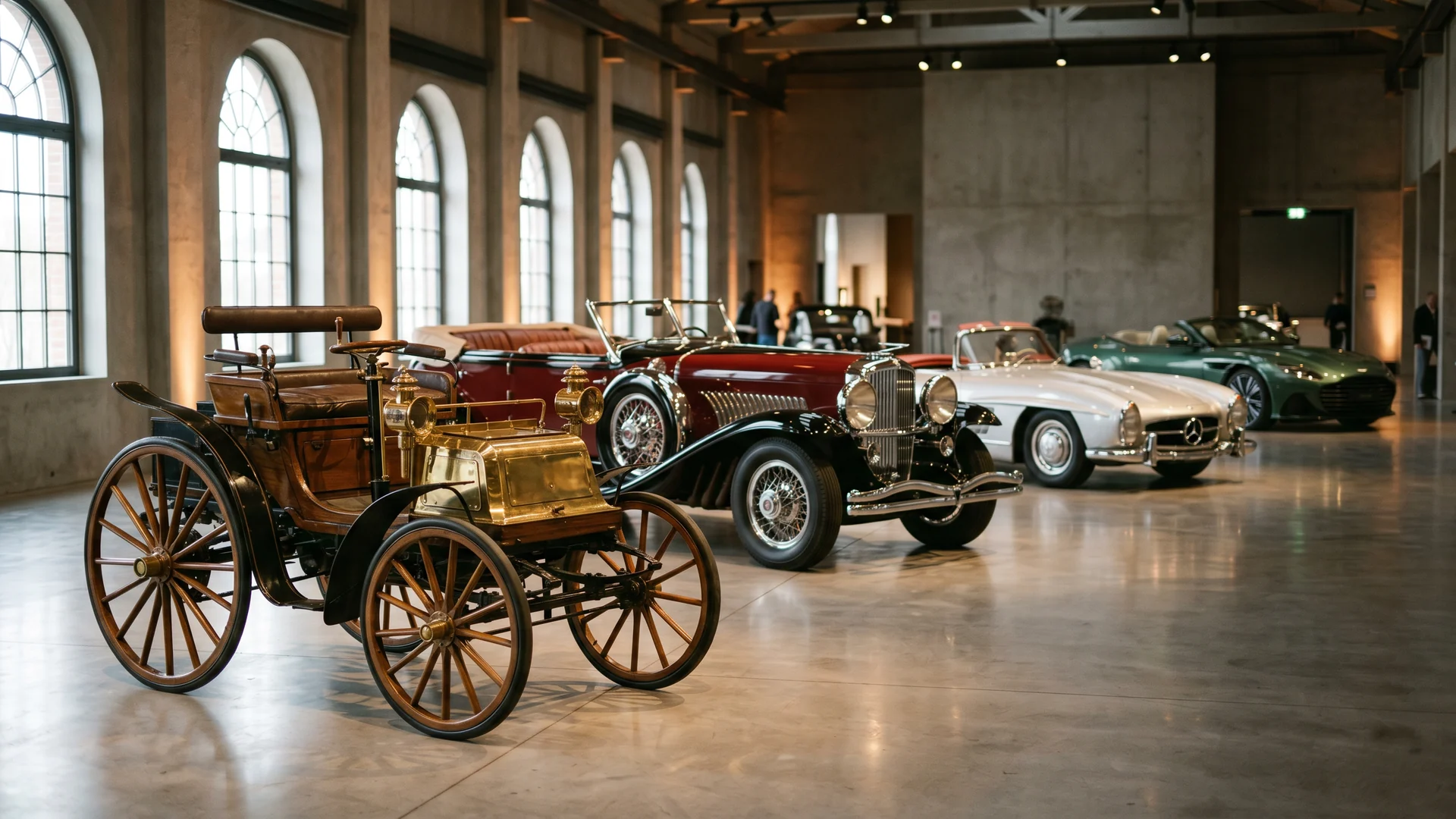
Classic Car History Timeline: From Benz to the Modern Collector Era
Classic car history timeline from the 1886 Benz Patent-Motorwagen through coachbuilding, muscle cars and supercars to modern collectibles. Discover th…